 Better Vision
Scott Bessent: Hamilton Inspires Trump's Economic Statecraft
Article from The Wall Street Journal. Published Tuesday, June 23, 2026. Written by Scott Bessent (U.S. Treasury Secretary).
-
Treasury's economic statecraft rests on five organizing principles: building national capacity in strategic industries, demanding reciprocity from trading partners, setting the rules for the next economy, wielding the dollar as a financial-statecraft tool, and ensuring policy benefits American workers rather than just markets.
-
"Setting the rules for the next economy" refers to the U.S. establishing the technical standards and protocols — for platforms, digital systems, and emerging technologies — that shape how 21st-century commerce operates, rather than just regulating the movement of physical goods.
-
"Wielding the dollar as a financial-statecraft tool" refers to using the dollar's central role in global finance to enforce compliance, including cracking down on sanctions evasion, terror financing, and other abuses of the financial system it underpins.
-
-
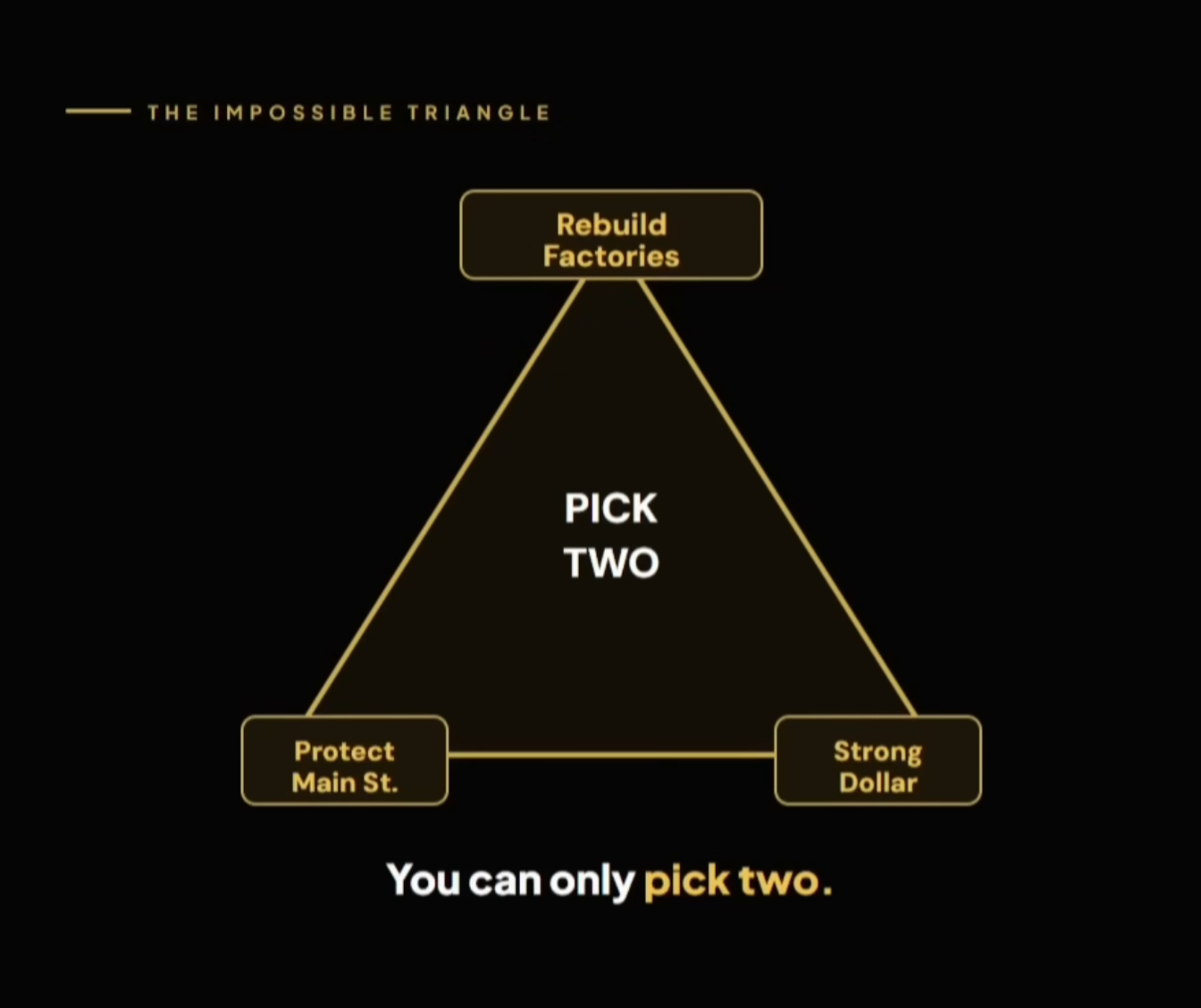
Analysts argue the U.S. is caught in an "impossible triangle" where it can only achieve two of three goals — rebuilding factories, protecting consumer purchasing power, and maintaining a strong dollar — and must sacrifice the third.
-
Rebuilding factories while protecting Main Street requires a weaker dollar, since an expensive dollar makes American exports uncompetitive.
-
Protecting Main Street while keeping the dollar strong means cheap imports keep flowing in, so factories never return.
-
Rebuilding factories while keeping the dollar strong requires steep tariffs, which raises consumer prices and fuels inflation.
-
THEY are preparing for $30,000 Gold - Here's Why That Should Scare You — Felix & Friends (Goat Academy)
China Is Preparing For $38,000 Gold — Andrei Jikh
-
The dollar is the most likely sacrifice, and gold would function as the "release valve" absorbing that adjustment.
- Evidence cited for this shift includes China's 20-consecutive-month streak of central bank gold buying, record U.S. gold exports to China, and China curbing retail paper-gold trading in favor of physical holdings.
-
Decades of financialization — the shift from producing physical goods to trading paper assets like stocks, bonds, and securitized debt — is cited as the underlying force behind the high price argument: as economies increasingly represent wealth through paper claims rather than tangible production, the physical gold actually available becomes a small base relative to the paper claims stacked on top of it, and that scarcity is what drives the case for a much higher price.
-
Analysts lay out two possible outcomes: a controlled transition where re-industrialization succeeds and gold gradually assumes a role as a neutral settlement asset, or a disorderly outcome where rising debt and eroding confidence trigger a more chaotic dollar/financial crisis.
-
Either path is framed as favoring a shift away from purely dollar-denominated savings — stocks, bonds, cash — toward real assets, with the difference being how fast and how painful the transition is, rather than whether it happens.